
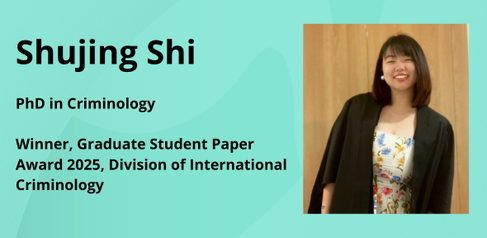
Shujing Shi, a PhD student at the Violence Research Centre,has been awarded First Place in the Graduate Student Paper Award by the American Society of Criminology's Division of International Criminology, for a chapter in her thesis.
Drug trafficking in China
Shujing decided to study the Chinese drug trade as there was little existing research on this subject. Much research into drug trafficking has focused on Western countries, with any findings specific to local context and unlikely to reflect the situation in Chinese society. A better understanding of how Chinese society engages with drugs is necessary to counteract this trade.
Her thesis, ‘Risk-taking, gender and networks: essays on Chinese drug trafficking’ examines organised drug trafficking in China from a network perspective. Her thesis interprets the concept of ‘network’ in three ways. The first is social network analysis, which analyses the structure of trafficking networks and the relationships between key 'nodes'. Shujing then provides an analysis of the networks' group typologies, which are often without rigid chains of command but are highly flexible and adaptive to specific environments. Finally, she introduces the concept of ‘guanxi,’ the system of interpersonal relationships and social connections embedded in Chinese society, which plays a critical role in fostering trust and managing risks. Drug trafficking is no exception. The presence of guanxi profoundly influences market exchanges and organisational operations.
Risk-taking and risk management in drug trafficking
Titled ‘Role-based Risk-Taking in Organised Drug Trafficking: An Analysis of Financial Interactions’, Shujing's award-winning chapter focuses on risk-taking within this illegal trade, and the power dynamics it creates.
“It's really hard to measure the risks around the market and how people take decisions based on those risks,” she explains. “So, we introduced a new framework to define and classify the level of risks from financial interactions – for example, how did they make their payments? And it gave each exchange party a risk level, based on their payment arrangements.”
Shujing developed a new measure to calculate the level of risk undertaken by different exchange parties. In the context of drug trafficking, this analysis defines the risks as risks of loss – specifically, the loss of drugs, money, or both. Drawing on an analytical framework that incorporates the role of guanxi, level of law enforcement risks, and various financial interactions, Shujing found that illicit drug markets are characterised by imbalanced risk-taking and power asymmetry. Market participants positioned as lower-level buyers face greater risks than upper-level sellers. This pattern was consistent across all types of market, from street-level vendors to wholesale suppliers.
“The sellers have more control over the market,” explains Shujing. “They are the ones who decide how much risk they want to in that market, which puts the buyers at very disadvantaged positions.”
Changing perspectives
Shujing extensively analysed the court files used as the data source for her paper. However, she notes that a critical engagement with data and well-formulated research questions are what truly make a difference. She credits the Institute of Criminology for helping her develop these essential skills. Support from her supervisor, Professor Paolo Campana, has also been instrumental throughout her PhD studies.
“He is an outstanding criminologist and dedicated mentor, who has helped me shape my understandings of, and appreciation for, what constitutes good research,” says Shujing.
It was also on her course that she first began working in drug rehabilitation centres, both in the UK and abroad. She cites this experience as pivotal in convincing her to study illegal drugs. Through these works, she came to understand that criminology is a warm-minded field, one that seeks to help and create change, rather than simply to judge or punish.
The chapter on risk-taking is part of a wider body of research into China’s drug trafficking. This is the second consecutive year that her research received an award from the American Society of Criminology. In 2024, she received first place in the Graduate Student Paper Award for another chapter in her thesis, which examines how the drug networks' structures have changed over the last decade.
Shujing's research aims to understand the nuances of drug trafficking in China. She hopes this will lead to more effective responses.
“I want to understand how people think and behave within a society”, she explains. “And I believe criminology is a good subject for exploring wider behavioural patterns.”