

Kate Herrity, visiting scholar at the Institute of Criminology, has recently completed two co-edited texts, one on sound and music in detention, in collaboration with colleagues in musicology and the other on sensory criminology. They represent the culmination of extensive research on the subject, partially carried out over her five-year scholarship.
Sensory criminology refers to research into how the senses affect our experience of various aspects of the criminal justice system – from incarceration to violence. It stems from a wider recognition that our perception of the world is heavily influenced by our senses. Yet this fact has been overlooked in criminology.
The role of the sensory
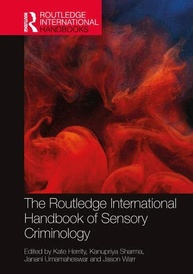
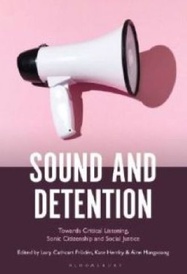
The books co-edited by Herrity are the ‘Routledge International Handbook of Sensory Criminology’, co-edited with Kanupriyal Sharma, Janani Umamaheswar, and Jason Warr, and ‘Sound and Detention: Towards critical listening, sonic citizenship and social justice’, co-edited with Lucy Cathcart Frödén and Aine Mangaoang. Both are due to be released by January 2026.
In ‘Sound and Detention’, Herrity, Frödén and Mangaoang wanted to decentre vision and focus on sound and music. They focused on confinement, as people’s experience with this system can have long-term psychological effects. Studying carceral environments can provide a better understanding of their long-term harms. She argues that sound can influence how those who live and work in carceral spaces perceive time, and the configuration of power and order.
“I aim to explore these tensions between sound and music in places of confinement,” she says, “and I want to ask what listening nearby does for how we understand the experience.”
The book has nearly 40 contributors from across the world, including Scotland, Germany, Uganda, Eritrea and Gaza. They include junior academics, activists, artists, practitioners, and people with lived experience of confinement. Herrity credits Lucy Cathcart Frödén for encouraging contributions from outside conventional academia, to broaden the perspectives on the subject. The essays are accompanied by ‘interludes’ -shorter, more creative pieces. An accompanying website hosted by Bloomsbury will showcase music and sound art, with plans for a podcast in the future.
Herrity explains, “we wanted to explore the meeting points between criminology, sound studies, musicology, and activism, and what it is to deal with that sensitively, creatively.”
The ‘Routledge International Handbook of Sensory Criminology’ expands on the sensory dimensions of criminology. A number of contributions focus on environments - streets, courtrooms, museums, and marine ecosystems. The 29 chapters come from an equally diverse range of people as ‘Sound and Detention’, with subjects ranging from the 2021 Capitol Hill riots to noise and light pollution.
Expanding sensory criminology
Herrity has already produced extensive work on sensory criminology. Her book ‘Sound, Order and Survival in Prison: The rhythms and routines of HMP Midtown’ received the British Society of Criminology’s annual book prize in 2024. It applied the concept of sensory criminology to a local men’s prison, detailing its soundscape and how it affected the prison social world.
She also co-edited the volume ‘Sensory Penalities: Exploring the Senses in Spaces of Punishment and Social Control’ with Bethany Schmidt and Jason Warr (both formerly of the Criminology Institute) and created the Sensory Criminology blog to accompany the volume, discussing subjects ranging from psychoactive drugs to the effects of darkness on policing. Herrity hopes her work can expand the potential research areas in criminology, including how all the senses engage with these situations.
“The sensory landscape has implications for survivability, wellbeing and safety for all who move through prison spaces – and for changing how we understand trauma and violence,” she says, “so I would like to see that taken far more seriously. I make the point in the book that slow scholarship is increasingly difficult to do, but absolutely essential to create lasting ideas, as well as contributing to a more ethical practice both in the field beyond.”
The benefits of academia
Herrity returned to academia later in life. Completing a PhD at the University of Leicester in 2019 and working as a module leader at De Montfort University, she began her visiting scholarship at the Institute in 2020 when she took up a research fellowship in punishment at Kings college.
Prior to starting at Cambridge, her research into prison culture had brought her into contact with the Prison Research Centre (PRC). She recalls the conversations with them, discussing issues such as the nature of prison relationships and survivability of different sites as invaluable for broadening her perspectives on criminology. In her opinion, the PRC’s knowledge on prisons and shifting penal culture is unparalleled.
“My book was really enabled by the time and conversations the fellowship and scholarship made space for,” says Herrity. “Were it not for that, I don’t think I would have had the courage to write it in the way I did.
“I desperately wanted space and time to pursue research and writing. I’ve made connections in all sorts of fields and disciplines all over the world, and enjoyed a truly creative, nurturing research community.”
Future projects
Having completed both her scholarship and her bigger publications, Herrity hopes to focus on individual articles and creative projects. As she pursues this work, she hopes to maintain the collegiality that she experienced with her scholarship.
“Collegiality is profoundly important for sharing ideas, contributing to a broader conversation, and making more room at the table,” she says. “We all have a duty to do that. We should all want to do that rather than viewing success as a zero-sum game. We all thrive when we share ideas, and we all have perpetual debts to those who come before as well as those who follow. That is the grid and grammar of academia, we would do well to remember it.”