
Interview with Joanna Foster, MSt in Applied Criminology, Penology and Management
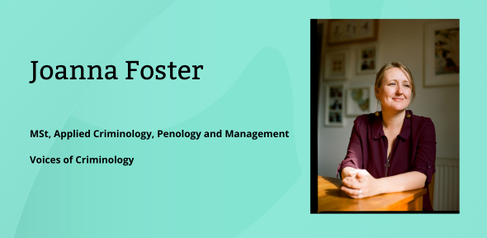
Can you briefly summarise your time at the Institute of Criminology?
I'm not sure how academically rigorous this word is, but it was fabulous.
I loved every moment of being at the Institute. It was a privilege to be at an institution that's so revered and respected and known globally. There were the tutors, the lecturers, our supervisors, librarians, the privilege of accessing all of these daily. Being part of a college allowed me to feel I was really part of something as I learned. So yes, I absolutely adored my time at the Institute.
What convinced you to do an MSt at Cambridge?
I'd reached a point in my professional career where I was very conscious about how fresh and accurate my perspectives were. Whilst all of us like to think we know best, I wanted to put that to the test amongst experts in the field, with a peer group that had very different experiences and knowledge to mine. That was what Cambridge offered.
My work is with children and teenagers who set fires. I work across the age spectrum, with different agencies, schools, social care, mental health, and youth justice, to understand what causes a child to start fires and how best to address it. Is it through fire safety education, or psychosocial intervention?
Despite being highly experienced in this field, I was ready to be challenged about the work that I did, my understanding of what causes harmful behaviour, and how we respond to it. I felt the need to explore this with a wider group of peers and academics, to have confidence that what I was doing on the front line was ethical and effective.
It was also different from other institutions in that you would come together as a cohort for a set amount of time. It wasn't distant learning; it wasn’t once a week. You spend a solid number of weeks with peers and the academics. And that's exactly what I was looking for.
Can you briefly describe your thesis?
My thesis reflected my work. One of the realities in this work is that unlike many other harmful behaviours, there is no risk assessment for child fire-setting behaviour. Therefore, practitioners are in a very vulnerable position, making decisions based solely in their professional judgement and experience. Therefore, my thesis explored what that was like for the fire service staff who have to do this work, in the absence of any risk assessment. How are practitioners making decisions around the level of risk?
A theme that came out- and I have to bow to the brilliance of my supervisor in teasing this out- was identifying the absence of legitimacy in this work. In my reading and in lectures, the theme of legitimacy had been very much rooted in police and prison work. What came through in my findings was those same considerations of what allows for legitimacy was coming through in my findings in the fire service.
If you have a workforce who are untrained in this field, who don't have supervision or access to risk assessments, then the questions of ‘how authoritative am I?’ or ‘who are the professionals in this field?’ come through very powerfully. This was alongside the absence of recognition of the real emotional labour of this work.
I expected the findings to show that the absence of risk assessments led to individual decision making with all its associated vulnerabilities. But this wider lens of vulnerability and absence really opened up in my thesis.
What was the most important thing this course has taught you?
I'm still working in the field, and my time at the Institute and Cambridge has given me greater authority in that field. Now I’m able to layer over 20 years of working in this field with my own research and present those findings to bodies like the National Fire Chiefs Council, to say these are the gaps in practice. The University of Cambridge has allowed for more recognition of my authority on what I'm saying.
Perhaps the most important thing I took away from the course is openness. Whether that's an openness to be challenged by your peers, an openness to be challenged by your supervisor, and openness when the librarian suggests you read this person's thesis. Be really open to challenge and critique. Therein lies the learning. And of course, be open to other people's disciplines and knowledge.
What advice would you give to somebody who was starting your course?
Be greedy for all that the Institute and the university can offer, because it's only a very short time that you're there. So be open to all the different opportunities.
Also, and I know this sounds really obvious, but plan and be organised. This is a massive commitment, and we go into it knowing that’s the case. But you don't really realise it until you're there. You have your reading, your essays, and your thesis, so it really is about setting boundaries with your time for everything. The more you can plan and organise for that, then hopefully the less painful it will be. It's painful at times. Of course it is. It's a demanding course. It has to be.
But the more you can be ready for that and prepare for it, you can make it doable, manageable, and ultimately enjoy it.