
Interview with David Cowan
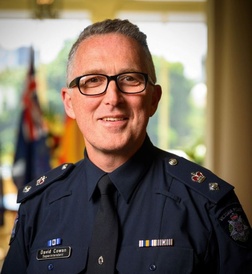
Can you briefly summarise your time at the Institute of Criminology?
I was here in 2017 and 2018 on the MSt programme. I was with 60 mid-ranking police officers from 10 countries, and it was a great experience to come from Australia and undertake the programme and hear the amazing content within it. But it was also great to share that experience with police from all around the world.
What convinced you to study Criminology?
About five years prior to coming here, I went to the first evidence-based policing conference in Australia, and for the first time in my career, I heard a discussion around a whole body of knowledge that I hadn't been exposed to. I'd been a police officer for 25 years at that point, and I've been taught very proficiently on how to use force against other human beings. But I hadn’t been given instruction on how I might implement effective policing strategies, how to test whether they worked, or how to use a whole body of applied policing research. The conference opened up my eyes to evidence-based policing, research and criminology. From that point, I was looking at opportunities on how I could build my knowledge.
Fortunately, one of my colleagues from Queensland police referred me to this programme. She had completed it, and she recommended me to the then-director of the programme, Professor Sherman. And from that point on, I thought there was an opportunity that I could go to Cambridge and study that had my name on it. I was very fortunate to get support, both from my agency and some funding through the Institute and it all came together.
Why did you decide to come to Cambridge?
Cambridge at the time had the most credible programme around evidence-based policing. In fact, I wasn't aware of any other criminology institute that really focused on applied and experimental criminology. That's what interested me. And you had the best academics in the world here, who were leading that whole body of research.
So, there was no other decision, other than to come to the Institute of Criminology.
Can you briefly describe your thesis?
My thesis was on reducing repeat offending, through less prosecution.
It was an analysis of diversion with a deliberately controversial heading, because it sounds a bit contradictory: reducing repeat offending through less prosecution. It sounds like you're going soft on offenders, when in fact you're not. What I actually did was analyse over a million criminal cases that had been brought before the courts over 10 years in Victoria.
What I found was that the use of diversion dropped in half over that period. In fact, there were 115,000 missed opportunity cases, as we called them, because if the rate had stayed the same another 115,000 cases of diversion would have proceeded. We applied the best evidence to those 115,000 cases, and the evidence showed that diversion reduces repeat offending. Then for an offending cohort, we calculated that if the diversion rate had stayed the same, we could have prevented 37,000 offences from occurring.
It was an illustrative example, and we weren't precisely saying how much the benefit would be. But I think the analysis was helpful for police in showing that diversion reduces crime. This was my first academic publication, which I would never have dreamed of doing. To do so with Professor Sherman and Professor Strang as co-authors was a privilege.
What have you gone onto since graduating?
I'm the President of the Australia and New Zealand Society of Evidence-Based Policing. There are other societies of a similar nature around the world. They’re all similar, in that they're a group of police who want to communicate, use and generate the best evidence in policing, to make policing effective and keep the community safe. We've held three conferences since that time. We have published 27 editions of our own journal, Police Science Journal, with practical police-led research that we shared across policing in Australia and New Zealand.
I've also been fortunate to undertake a Winston Churchill Fellowship looking at evidence-based policing worldwide. I went to five countries and interviewed people, police and academics leading in this space and published my Winston Churchill Fellowship on my worldwide investigation.
Can you give some examples of how you have used learning from the course in your career?
I have run a number of experiments since leaving the programme, because the programme equipped me with the skills to lead that in that field. I ran a hotspot randomised trial, to test the benefits of increased place presence in persistent crime locations. I ran an experiment focused on reducing serious public violence, where we identified 1000 offenders who were at risk of committing violence on the streets. We randomly selected 500 to get focused deterrence visits, and that was successful. After 500 days we could show that it reduced repeat offending in those offenders by 25%.
I ran a police trust and confidence trial during COVID, when police had to check thousands of people on the street for compliance to COVID orders. We had officers who were trained in procedural justice as the treatment group, and other officers who were not trained as the control group. Officers gave out surveys to the public and we compared the results. It was a fascinating experiment, and we learnt a lot about police- citizen interactions, which are so important in building trust with the community.
I've just finished analysing a trial, using behavioural science to reduce court absence and warrants for arrest being issued. We basically improved the summons form using nudge theory, providing simplified information to accused persons and highlighting the risk of non-attendance. We randomly assigned 60,000 cases over 12 months to 4 conditions, with 3 versions of the new form tested against a control group. And it worked! We reduced failure to appear by 10%, with a cost benefit of over 1,000 policing days.
Importantly, it was almost twice as effective at reducing arrest for indigenous persons, as we included a QR code on the form to directly connect them with Victorian Aboriginal Legal Service. This is a really important outcome as indigenous persons are the most disadvantaged group in the criminal justice system.
I’ve been recognised for my work in this field. In the USA, I was inducted into the Evidence-Based Policing Hall of Fame by George Mason University in 2024. That same year, I was also awarded the Sir Robert Peel Medal for leadership in Evidence-Based Policing, here at the Institute of Criminology, Cambridge University. And in November, I will be admitted as an Honorary Fellow of the Academy of Experimental Criminology, at the American Society of Criminology Conference.
What was the most important thing criminology taught you?
The most important thing I learned was that police can lead change and operations on the ground and test those strategies for effectiveness. Unfortunately, much of policing is untested for effectiveness, and is guided by intuition and experience. Some things work, some things don't make a difference, and some things might be called well-intentioned cures that actually harm. We don't really know.
I'm not saying policing needs to stop being reactive. That is the game of policing. But there is significantly more that policing can do to test effectiveness. The use of randomised trials and experimental design is critical in policing. It could be said that without evidence, all policing strategies are doomed to succeed. The importance of running experiments on the ground as a police officer was the number one skill I learned in undertaking this programme.
What advice would you give to somebody who was starting your course?
Well, in reflection the course is largely two distinct components. There's Year One, where you're given the opportunity to be exposed to this whole body of knowledge around criminology. This opens your eyes up to so much that you didn't know, and it's completely fascinating. So, what I would say is immerse yourself in all that and learn as much as possible. There will be things that will really resonate with you, and there'll be other things that just that just don't click. Push the latter aside and go with the stuff that you're finding interesting.
And then as you go into Year Two, that's when the more difficult work commences with your thesis. I think I would say to students about to undertake their thesis, to actually try and keep it simple. I think it's easy to try and over complicate it. But simple and important questions really will resonate with people.
Use your analysts and your colleagues to get access to the best data that you can, because the data will underpin the whole your study. Find those people and they will be your best source of assistance, because if you can get your data right then you can do the work of analysing that data.
Finally, as you shape your thesis, always remember that document has the potential to inform other police around new knowledge on important subjects. So always apply a practical lens to what you're doing, so that other police can use that knowledge going forward.
29 September 2025