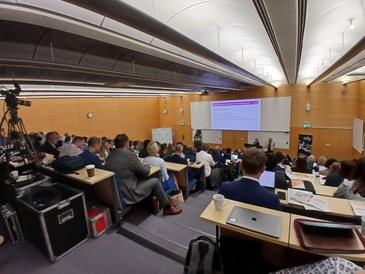
Evidence Based Policing Conference: What Works for the Frontline?

The Institute of Criminology held the annual criminology conference on 11-12 September, in collaboration with the Society for Evidence-Based Policing (SEBP). The conference was also co-hosted with the College of Policing, the London Mayor’s Office of Policing and Crime, and the Home Office.
Evidence-based policing aims to use the best available evidence to inform and improve upon police practices. Dr Peter Neyroud, an Associate Professor in Evidence-Based Policing at the Institute of Criminology, chaired and co-hosted the event.
“What I witnessed as a police officer of more than 30 years – of which more than half was as a chief officer – was that we did far too many of the important things where there was no significant underpinning with research,” says Neyroud. “Far too many decisions were taken before decent numbers were done, to see whether it was a sensible thing to do.”
This year’s conference, ‘What Works for the Frontline?’, explored the issues with frontline operations, and what the evidence says can be done to improve them.
This issue has been at the forefront of conversation around policing, in the wake of falling detection rates within UK forces. While this conference included a variety of speakers with different experiences, many of them raised the same issues.
One recurring topic was violence against women and girls. The speakers on this subject came from a variety of fields. Abu Ullah, a Masters student in Criminology and former member of the London Borough of Sutton Council, discussed how sexual predators concentrated in small areas. Within the London Borough of Sutton, these proved to be outside girls’ schools at the end of the school day. Once this was known, police were able to intervene far more effectively.
Detective Inspector Tina Wallace from Thames Valley Police discussed Project Vigilant – an initiative aiming to improve policing of the night-time economy. This was done by pairing non-uniformed surveillance officers and uniformed officers. The former could identify predatory behaviour with less chance of detection, with the latter then intervening after enough information was gathered.
Several speakers and attendees also explored alternatives to charging and prosecution. This topic has gained interest in the UK in response to overcrowding in prisons. Low-harm offenders, who are unlikely to either reoffend or cause serious harm, currently account for 60% of those prosecuted in the UK. There is a growing body of evidence that other approaches, such as cautioning with conditions or deferred prosecution, may be more appropriate for them. It is likely to reduce reoffending and increase prison space.
Neyroud also highlighted the presentations of two PhD students at the Institute of Criminology: Emily Quin and Jacob Verrey.
Quin discussed her research into psychological illness among frontline forces. In the UK, this is now one of the largest causes of officer absence. Her research will help police forces implement mental health provision, targeting the specific psychological issues frontline staff face.
Meanwhile, Verrey discussed the potential for artificial intelligence (AI) in policing. Specifically, he focused on how machine learning could process crime more efficiently. This would involve training AI systems on police databases, to understand trends in different types of crime. Verrey’s presentation explored the ethics of machine learning, and how police could be trained to use it. The machine learning model he describes could be invaluable in determining serious offenders’ likelihood of repeat offending.
The focus was predominantly on UK policing, but the conference also attracted interest from around the world. Neyroud spoke to Irish police officers about the potential for an Irish Society of Evidence-Based Policing.
There was also considerable international interest in rapid video response calls. These involve crime victims speaking directly to a police officer over a video call, to arrange a service proportionate to their need. Originally, they were trialled in parts of the UK to assist domestic abuse victims. Their effectiveness has led to them being expanded to other crimes, as a way for police to allocate resources more efficiently. Neyroud described them as “eminently spreadable”, and attendees from both Denmark and Saudi Arabia expressed interest. In total, the speakers and attendees at this year’s SEBP Conference came from 14 different countries.
Dr Neyroud believes this demonstrates the success of the SEBP Conference and the impact it can have:
“It's a great opportunity to showcase what Cambridge does, a great opportunity for SEBP to spread the word, and a great opportunity to showcase British policing research, carried out by practitioners, to a worldwide audience.
“The Institute of Criminology was set up in 1959, to take the best research and spreading it to the field of practice and policy. And I think the conference was absolutely about that.”
In the evening, delegates enjoyed dinner at St John's College, Cambridge
September 2024